

Choosing between a TFSA (Tax-Free Savings Account) and an RRSP (Registered Retirement Savings Plan) is one of the most important financial decisions for individuals in Canada. Yet this question is often oversimplified, as if there were a universal answer that applies to everyone. In reality, the right choice depends on your current tax situation, your income level, your financial goals, and even your long-term life plan.
In this article, we provide an in-depth and structured analysis of TFSA vs RRSP to help you determine which one to choose based on your personal situation. The goal is not to declare a single winner, but to give you the tools to make an informed, coherent, and tax-efficient decision.
Understanding the Basics: What Is a TFSA and What Is an RRSP?
Before comparing the two, it is essential to understand their underlying tax logic, because TFSAs and RRSPs do not follow the same taxation rules.
The TFSA: A Tax-Free Growth Vehicle
A Tax-Free Savings Account (TFSA) is a registered account in which:
contributions are not tax-deductible;
all investment income (interest, dividends, capital gains) is completely tax-free;
withdrawals are not taxable and do not increase your taxable income.
In other words, the TFSA acts as a tax-neutral zone for the growth of your savings.
The RRSP: A Tax Deferral Tool
An RRSP works in the opposite way:
contributions are deductible from taxable income;
investment income grows tax-deferred;
withdrawals are fully taxable when they occur.
An RRSP does not eliminate taxes—it defers them, ideally to a period when your tax rate is lower.
TFSA vs RRSP: A Fundamental Difference in Tax Philosophy
The core distinction between TFSA vs RRSP lies in when taxation occurs.
The TFSA is taxed before contribution (after-tax dollars).
The RRSP is taxed at withdrawal (pre-tax dollars).
This difference has major implications for:
your annual taxable income;
eligibility for government benefits and credits;
retirement income and withdrawal strategies.
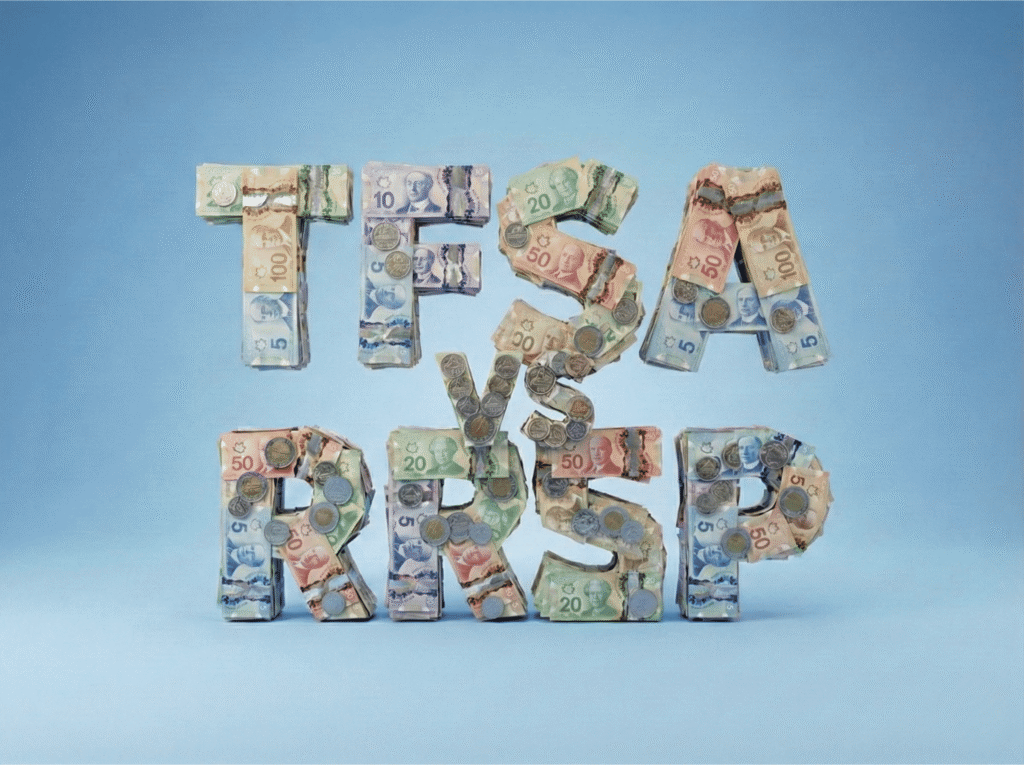
TFSA vs RRSP: Summary Comparison Table
| Criteria | TFSA | RRSP |
|---|---|---|
| Minimum age | 18 | None |
| Maximum age | None | December 31 of the year you turn 71 |
| Contribution deductible | No | Yes |
| Investment income taxed | No | Deferred |
| Withdrawals taxed | No | Yes |
| Impact on government benefits | None | Possible reduction |
| Contribution room restored after withdrawal | Yes | No |
| Spousal option | No | Yes (spousal RRSP) |
When Is a TFSA More Advantageous?
The TFSA is often underestimated, yet it is one of the most powerful financial tools available in Canada.
1. Low to Moderate Income Earners
If your current marginal tax rate is low, the RRSP deduction provides limited immediate benefit. In such cases, a TFSA is often preferable because:
you do not waste a low-value deduction;
you maintain full flexibility over withdrawals;
you avoid all future taxation on investment growth.
2. Young Professionals and Self-Employed Individuals
Early in a career or with variable income:
the TFSA allows saving without locking funds;
withdrawals do not increase taxable income;
contribution room is restored after withdrawals.
3. Medium-Term Financial Goals
Home purchase, business projects, emergency funds:
TFSA withdrawals are penalty-free;
no repayment obligation;
no indirect tax consequences.
When Does an RRSP Make More Sense?
The RRSP remains central in specific tax-planning situations.
1. High Income and High Tax Rates
When your marginal tax rate is high:
RRSP deductions generate significant tax savings;
they can substantially reduce tax payable;
they may increase eligibility for certain credits.
2. Structured Retirement Planning
The RRSP is designed to:
accumulate long-term retirement savings;
smooth taxation over time;
convert into a RRIF or annuity at retirement.
3. Spousal RRSP Strategies
Spousal RRSPs allow:
income splitting at retirement;
reduced overall household taxation;
improved estate and retirement planning.
TFSA vs RRSP: Impact on Government Benefits
This is a critical but often overlooked aspect.
TFSA
Withdrawals do not increase taxable income.
No impact on:
Old Age Security (OAS);
Guaranteed Income Supplement (GIS);
income-tested tax credits.
RRSP
Withdrawals are fully taxable.
They may:
reduce or eliminate benefits;
trigger OAS clawbacks.
Can You Use Both a TFSA and an RRSP?
Absolutely—and this is often the optimal strategy.
A combined approach allows you to:
optimize taxes today with an RRSP;
preserve future flexibility with a TFSA;
adapt withdrawals based on your tax situation in retirement.
The real question is not always TFSA or RRSP, but how to use both strategically.
Practical Strategies by Profile
Profile 1: Young Worker with Modest Income
Priority: TFSA
Goal: flexibility and tax-free growth
Profile 2: High-Income Professional
Priority: RRSP
Complement: TFSA for diversification
Profile 3: Self-Employed Individual
TFSA for liquidity
RRSP depending on income stability
Profile 4: Pre-Retiree
Careful analysis of future tax rates
TFSA as a strategic withdrawal tool
Common Mistakes to Avoid
Contributing to an RRSP without real tax benefit
Making RRSP withdrawals without planning
Ignoring the impact on government benefits
Using a TFSA only as a low-interest savings account
Conclusion: TFSA vs RRSP Is a Strategic Decision
The question “TFSA vs RRSP: which should you choose based on your situation?” has no single answer. The right decision depends on:
your current income;
your marginal tax rate;
your short-, medium-, and long-term goals;
your overall financial and tax strategy.
In many cases, the best choice is one that fits into a global financial plan, aligned with your Canadian and Quebec tax reality.
Professional guidance can help avoid costly mistakes and ensure every dollar saved is optimized.
FAQ — TFSA vs RRSP
Is a TFSA truly tax-free?
Yes. All investment income and withdrawals are completely tax-free.
Is an RRSP always beneficial?
No. It is most effective when your future tax rate is lower than your current one.
Can an RRSP result in a tax loss?
Yes, if withdrawals are taxed at a higher rate than the deduction saved.
Which account is better with variable income?
The TFSA generally offers greater flexibility.
Is it too late to contribute to an RRSP at age 60?
No, but a personalized analysis is strongly recommended.